

Why Siri Sucks, for Now
Apple's patience in AI won't last

I could be screaming at Siri to call 911 and she’d give me directions to a pet store…
My brain is exhausted from reading “AI” everywhere across global, local, and useless news. I’m trying to make this newsletter useful: Grand Technologies assesses how technology transforms our daily lives. AI is reshaping work and our life. Apple makes deeply influential technology, but Siri, one of the first widely available virtual assistants, feels completely missing from this most recent wave… why?
Apple first failed to compete with its direct rivals in AI products. Now it’s pivoted and spun their failures into a conscious act of strategic patience. They scripted a demo—“What time does mom’s flight land?”—then that very function was nowhere near functional upon release.1 The feature that summarized headlines and texts was accused of spreading misinformation.23

Source: MacRumors
Meanwhile, AI tools from its familiar rivals have dominated the market and captivated the hearts of millions. In turn, Apple preserved its Siri architecture, jammed ChatGPT in it to tough out hard questions, and rolled out a disappointing set of features called “Apple Intelligence” throughout its interface.
Apple believes the heavy investments by its competitors won’t build a meaningful moat that will pull consumers away from its walled garden ecosystem. Yummm… those beautiful blue texts. Apple is waiting for its competitors to improve the underlying technology. So far, their strategic patience appears to be paying off. Competitors spend enormous sums to compete in a market where the products are becoming interchangeable.
In the past two months, early products are emerging with enough accuracy to reason, plan, and act on our behalf. This suggests we are shifting eras in AI’s evolution. Every agent will compete on how well their systems seamlessly integrate into our lives when acting on behalf of us. That’s Grand Technology on the horizon, bound to stick around. For Apple, the question ahead is when they enter with their own upgrade to Siri. The fact that early adopters use agents now suggests that Apple will follow later in 2026.4
Be the best, not first.
“We’ve rarely been first.. There was a PC before the Mac; there was a smartphone before the iPhone; there were many tablets before the iPad; there was an MP3 player before iPod.” - Tim Cook
Remember the Blackberry, Palm, and Nokia? Those smartphones dominated the industry before the iPhone launched. My grandfather and aunt both used the Palm Pilot; it was early and janky. Then the iPhone came along and within a year, all my neighborhood friends had one: teachers, lawyers, truckers, doctors, foremen— its adoption was far more widespread in everyone’s professional and personal lives.
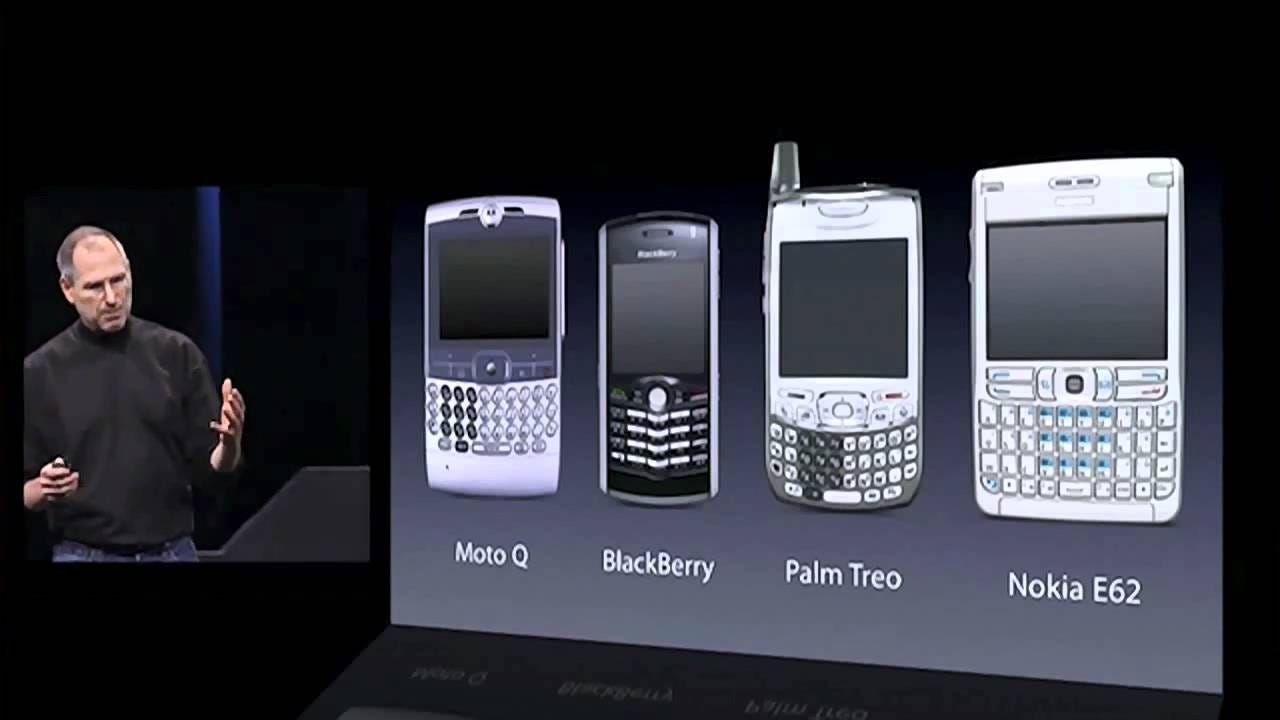
Source: iPhone Keynote 2007
When the iPhone released, Nokia sounded the alarms.
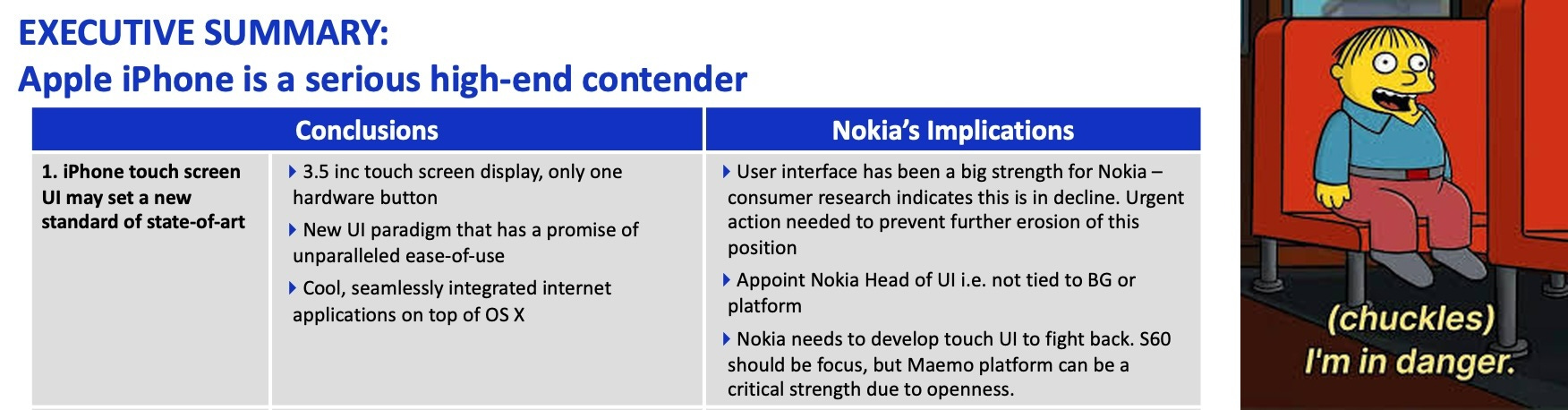
The left is the real deck from the Nokia executives after the iPhone launched. The right is how the room felt.
Source: Nokia Design Archive
When Apple arrived with the iPhone, Nokia failed to keep up.
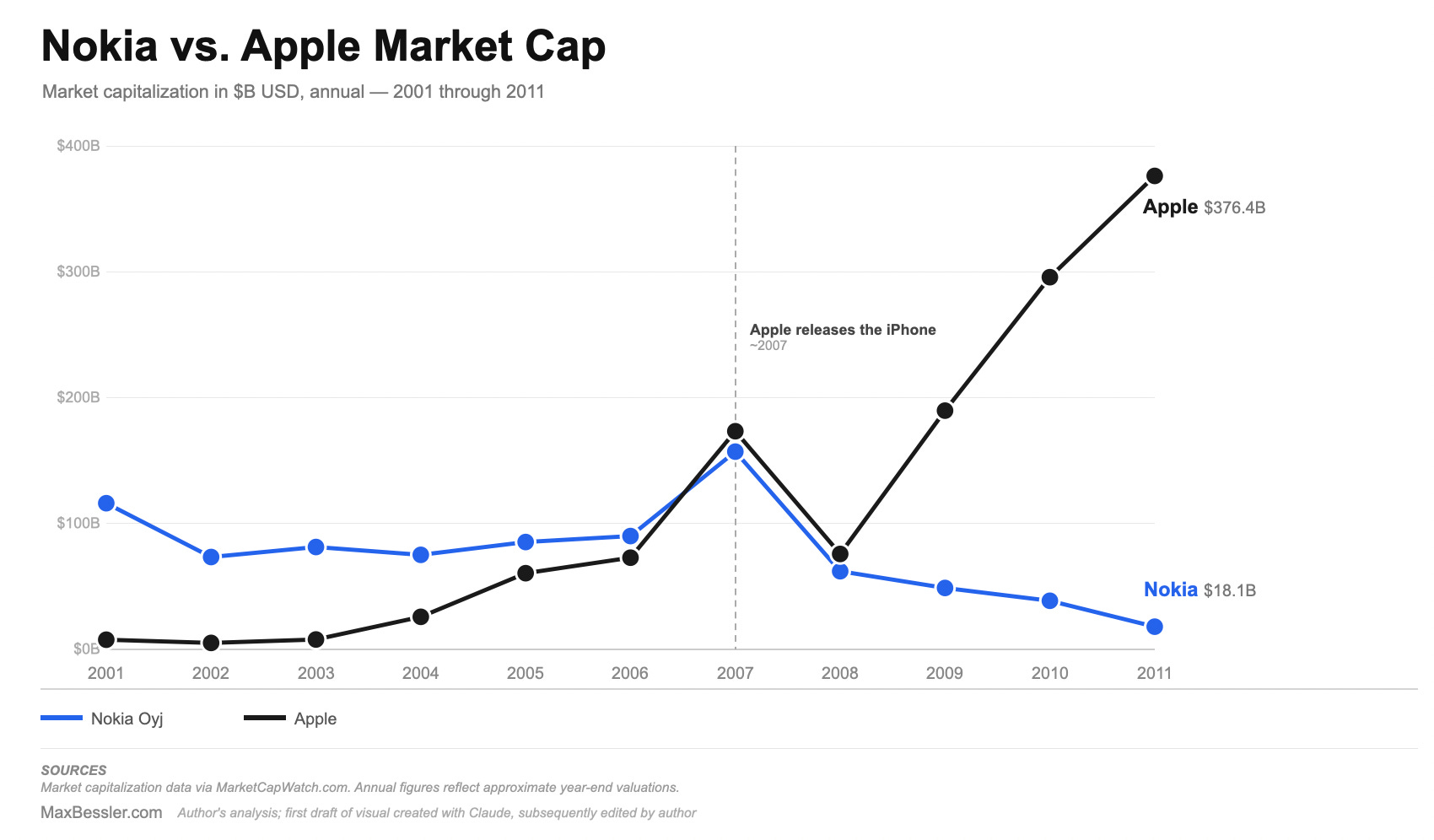
This is not the first time Apple has been “late” to refining technology into excellent experiences: tablets, MP3 players, or wireless earbuds. Siri sucks as an assistant because the technology that automates cognition is still being refined.
Today’s Toolbelt Behavior in the Generative Era
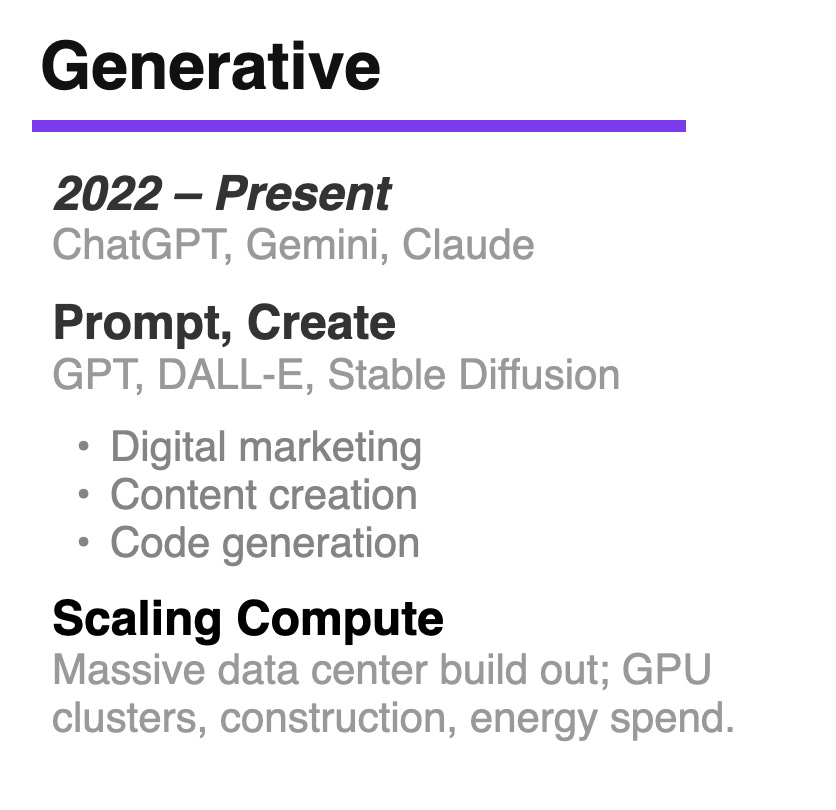
Since the release of ChatGPT, we’ve been in the Generative era where users prompt and create digital content to draft emails, research reports, make to-do lists, or create fake banter in your group chat.5 6
Think of the arrival of this Industrial Revolution in stages: Perception was in the past, Generative is today, Agentic is being adopted, and Physical is taking shape.
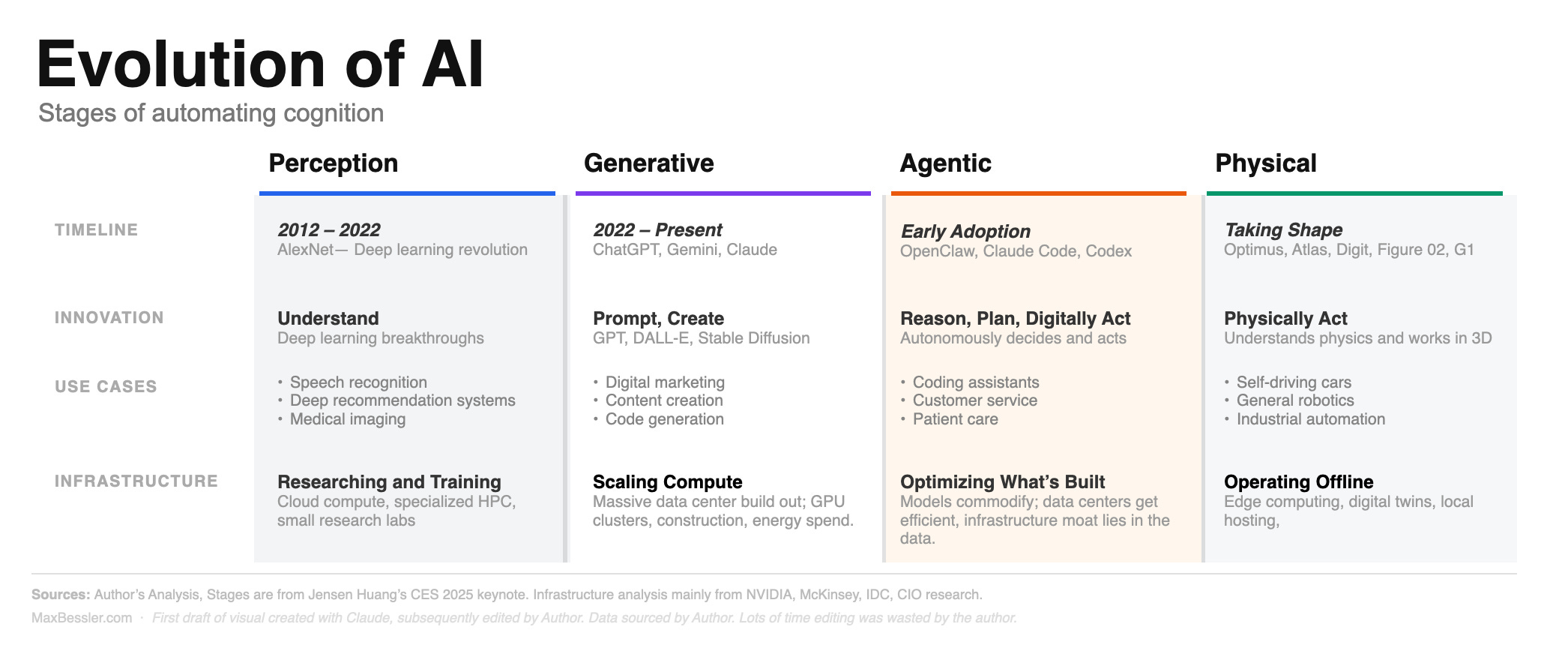
In today’s Generative era, consumers don’t care what model powers their use of ChatGPT, Gemini, or whatever tool they may use to prompt and create.
According to Maveron’s Consumer 2026 Report released last week, “56% of consumers are switching among AI tools” and exhibiting “toolbelt behavior” across various places in their work and personal life.7
A creative director told me, “I think it’s great to switch between AI tools with different capabilities. Chat can help refine responses and storylines put into image or video generation. They’re usually good enough because I edit it afterwards.”
Today’s power users aren’t married to any model. Levi Carlisle, co-founder of OpSprocket, a bespoke AI solutions consulting firm, uses several models in his personal and professional life. He says, “I regularly use Opus 4.6 and GPT-4o Mini, and now Gemini 1.5 and 2.5 in unison across the same workflow. They’re optimized for different parts of the stack. Most businesses don’t need frontier reasoning on every task.” And when it comes to capabilities, he notes that “for summarization, extraction, classification, and drafting, there often isn’t a meaningful performance delta.”
Apple is waiting to deliver the best experience in its ecosystem in the coming Agentic era. Users like Levi are already there, automating reasoning, planning and action for himself and clients outside the Apple stack— but as his domain expertise testifies, Siri needs to seamlessly do the same for 2.5 billion Apple devices. That’s a lot of product R&D, not infrastructure.
Today’s Rotten Business of Competing in AI Infrastructure
These products are amazing, but that’s the thing— they all are. When products are indistinguishable, that undifferentiated demand is bad for business trying to keep a margin.
Prices for Generative products are racing to the bottom. As Fortune reports, Anthropic recently cut prices by 67%, Google by 70-80%, and OpenAI continues to cut pricing as well.8 9 ChatGPT holds the lion share of users today from being the first, but they have to continue cutting costs to keep their lead as others do the same.
Improving the accuracy of models requires massive spending. In this Generative era, winning product market share depends on how much infrastructure a tech company can scale up its compute to improve the underlying technology known as “foundational models”. For example, the product layer is Gemini, Google improves its accuracy by spending billions on the infrastructure, data centers and the power, to train new versions and host older ones.
Apple Intelligence and Siri are abysmal because Apple isn’t spending billions in the infrastructure required to compete with its peers: Microsoft, Alphabet, Amazon, and Meta.
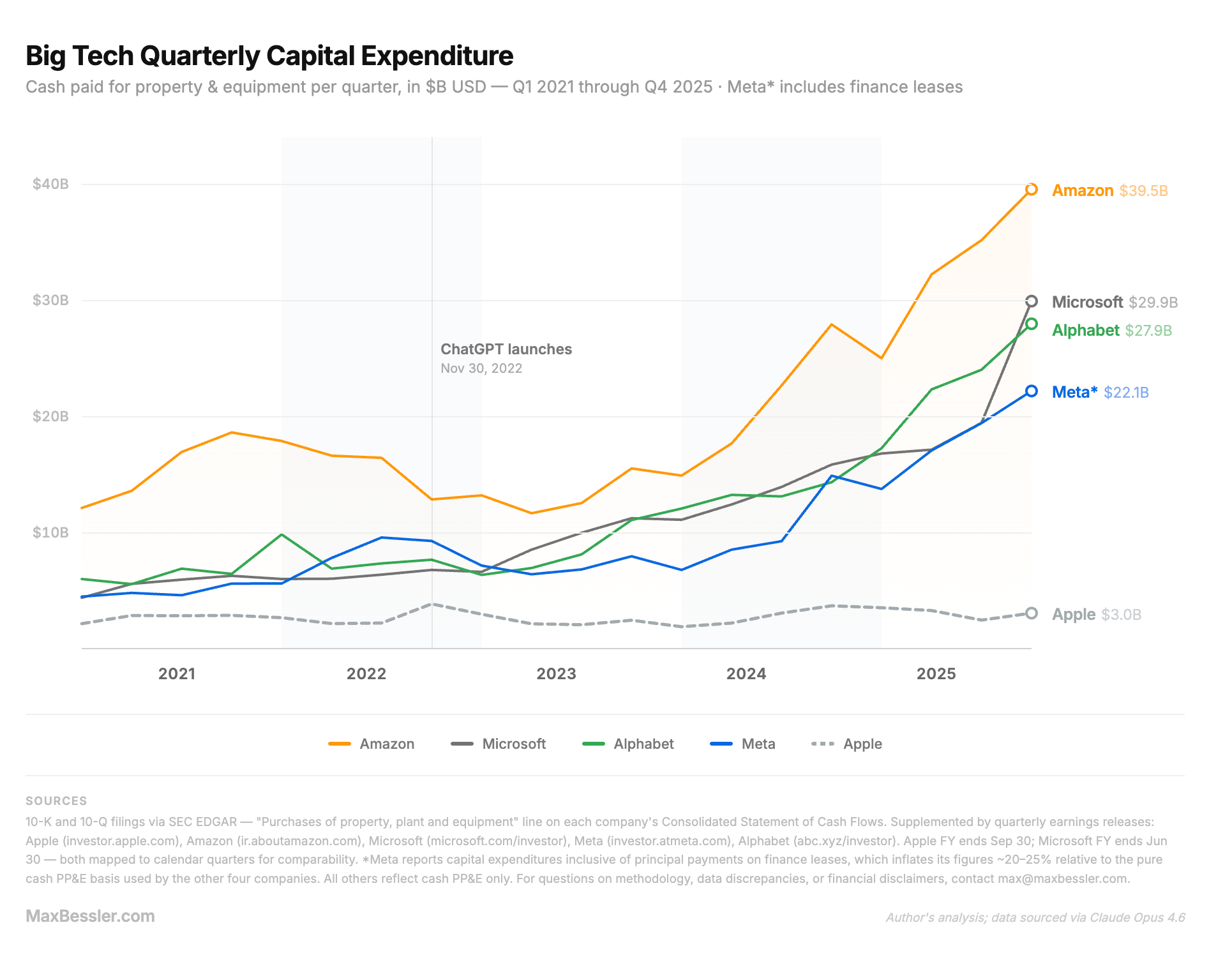
Future spending is not letting up. According to their first quarter earnings calls, these top four plan to spend more than $650 billion of AI-focused capital expenditure this coming year;10 Apple plans to spend $14 billion, even as Apple pursues a $1 billion licensing agreements for Google Gemini to marginally improve the accuracy of its tools.1112
“If we end up misspending a couple of hundred billion dollars, I think that that is going to be very unfortunate, obviously… But what I’d say is I actually think the risk is higher on the other side.” - Mark Zuckerberg13
Zuck sounds like a lunatic because he’s stuck in a digital arena. The big spenders are competing in a digital market of products where the switching costs for consumers are low. Apple’s competitors lack the hardware lock-in that let the engineers and executives in Cupertino bide their time.
Today’s infrastructure boom that could burst tomorrow
Winning customers in the Generative era demands massive infrastructure spend. That’s driving real returns through the economy— only exceeded by the hype that investors are pricing those tech stocks at.
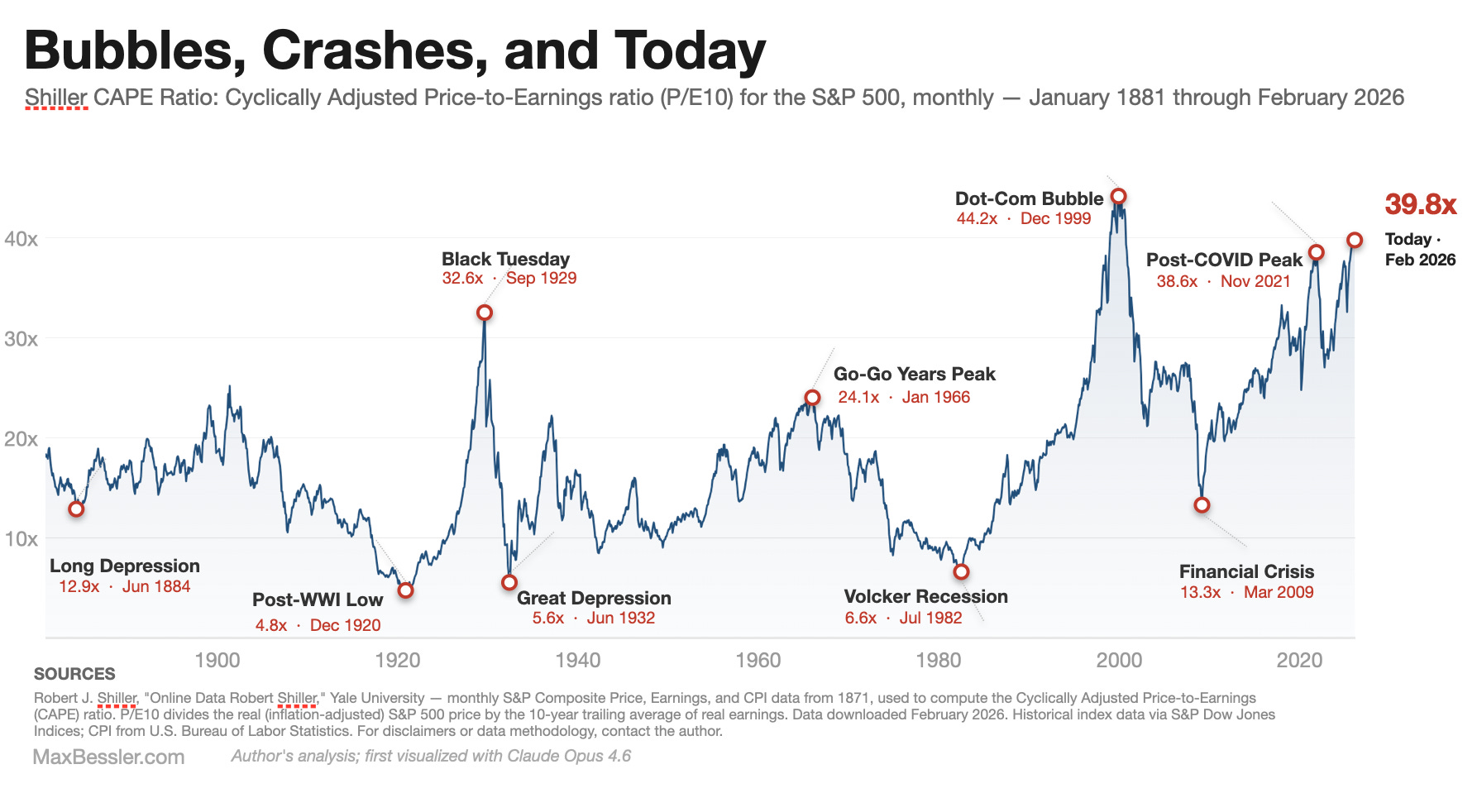
The sheer size of this spending asks a simple question: What is hype? What is reality? Apple’s thesis might be validated. Why spend billions to develop a product whose prices fall only to spend more on the next upgrade? Will all these data centers be needed? How fast will these products rip through the economy?
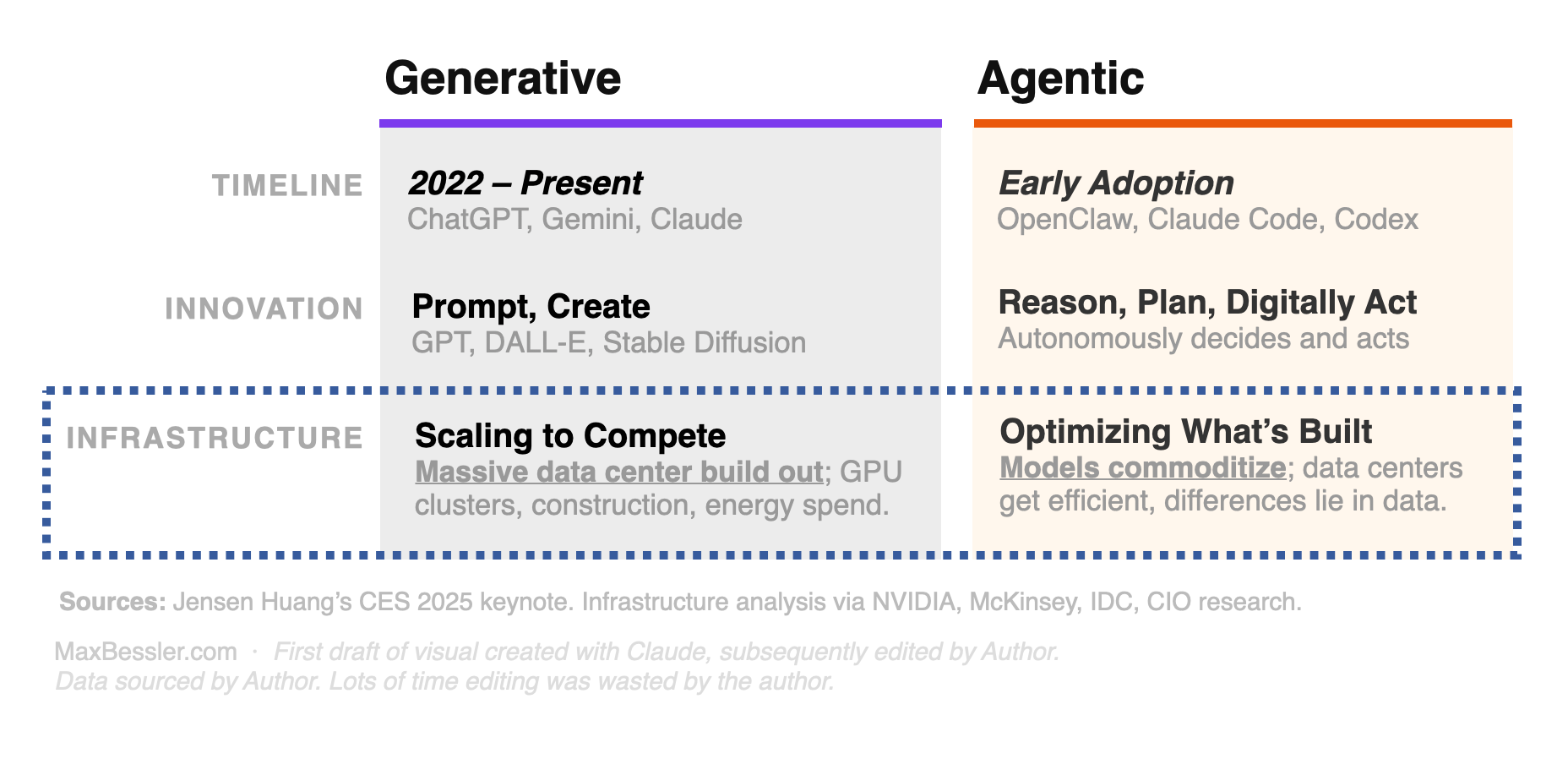
Investors are jumpy as the shift to the Agentic era begins. Products are emerging that suggest less data centers will be needed— and Agentic products will rip through the economy. On Sunday, a Substack Newsletter Citrini Research released a brutal scenario on how white collar industries could change; on Monday, the S&P fell 1%, losing roughly $550-600 billion in market cap.1415
Hey Siri, time to wake up!
In the Generative era, the models aren’t driving meaningful quality differences in the products. Most users are still warming up to a superintelligence helping them overcome email anxiety (just send the dam thing). ChatGPT and Gemini are both good enough for that job, but what about when the underlying models could read all our emails, triage your inbox, respond automatically, and put dinners on your calendar?
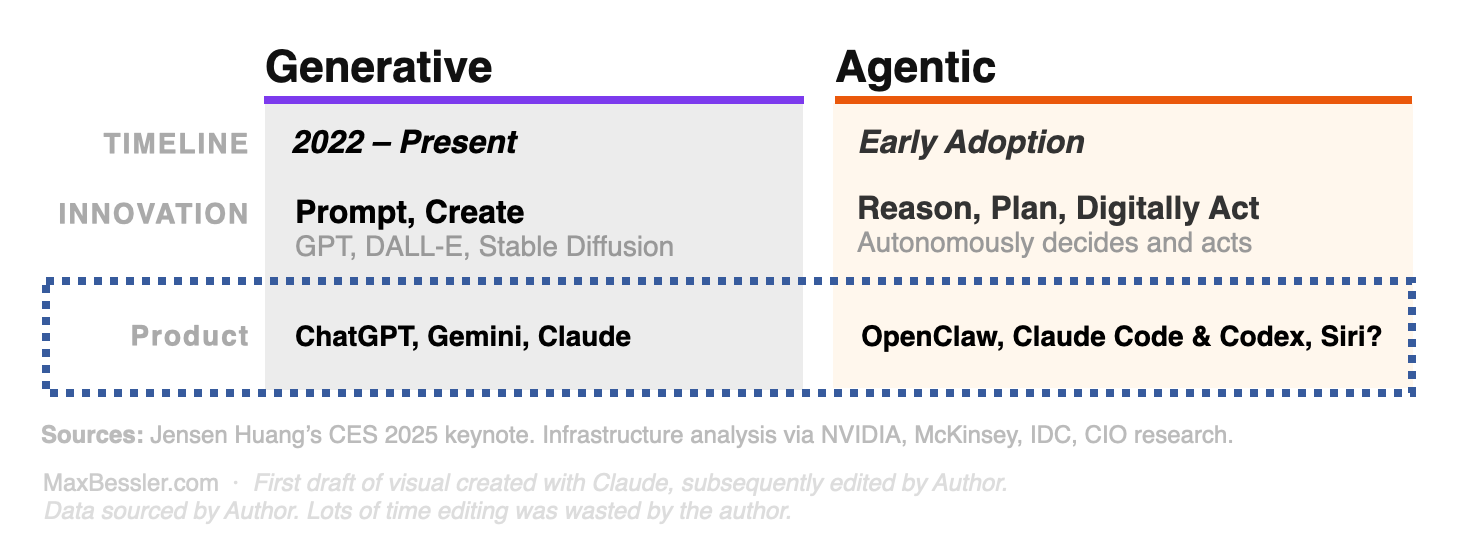
Apple’s is betting that the models are commodities; those don’t matter but the data does. For an assistant to reason, decide, and act, it has to know what’s going on in your life. Data will personalize these Agentic products, presenting an opportunity for real user loyalty— regardless of how marginally better the underlying foundational model could be.
I spoke with an analyst in cloud computing who summarized the difference of having data in the coming wave, “I like Claude, but ChatGPT knows so much context about my life that it’s becoming increasingly harder to use other products that could make decisions. It knows all about my relationships, my work, you know, my personal background. I’m comfortable giving it that data. We’re thinking about that with millions of people. It becomes harder for users to leave any one AI company.”
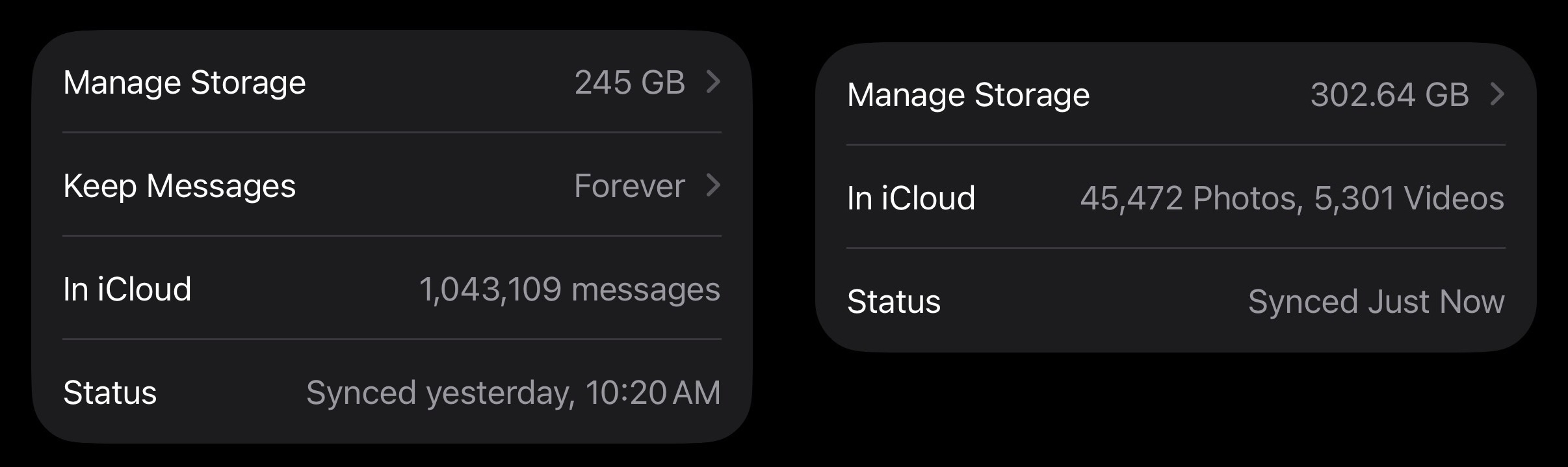
(Source: Settings > iCloud)
Like all the data barons, Apple sits on its own treasure trove of user information (including yours truly!) Apple will leverage its user data for intimate product experiences across its entire suite of hardware and services. The question is about timing. The longer it waits “to be the best”, the higher the switching costs are for consumers.
2026 is time for Siri to upgrade. The company sits on an estimated $130 billion in cash.16 If the market crashes from an infrastructure overbuild or Agents wipe out white collar work, Apple could buy, at a discount, any number of the over-built data centers or startups that were scrambling to catch the winds of the Generative era.
That’s Apple’s thesis— let’s watch 2026 and see if it works.
“Report Reveals Behind-The-Scenes Drama Over Fake Siri Demo At WWDC 2024,” BGR, https://www.bgr.com/tech/report-reveals-behind-the-scenes-drama-over-fake-siri-demo-at-wwdc-2024/
Apple’s Inaccurate AI News Alerts Shows the Tech Has a Growing Misinformation Problem,” CNBC, January 8, 2025, https://www.cnbc.com/2025/01/08/apple-ai-fake-news-alerts-highlight-the-techs-misinformation-problem.html
“BBC Calls Out Apple’s AI Feature for Creating More Fake News Headlines,” MacRumors, January 6, 2025, https://www.macrumors.com/2025/01/06/bbc-calls-out-apple-ai-creating-fake-news-titles
Apple to revamp Siri as a built-in chatbot, Bloomberg News reports https://www.reuters.com/business/apple-revamp-siri-built-in-chatbot-bloomberg-news-reports-2026-01-21/
“2025: The State of Consumer AI,” Menlo Ventures, https://menlovc.com/perspective/2025-the-state-of-consumer-ai/
What Consumers Are Doing Now and What Comes Next,” Maveron Consumer 2026 Report, __https://maveronvc.substack.com/p/what-consumers-are-doing-now-and
“What Consumers Are Doing Now and What Comes Next,” Maveron Consumer 2026 Report, __https://maveronvc.substack.com/p/what-consumers-are-doing-now-and
“Google and Anthropic Drop AI Prices and Release New Models,” PYMNTS, __https://www.pymnts.com/artificial-intelligence-2/2025/google-and-anthropic-drop-ai-prices-and-release-new-models/
“While Big Tech Burns Cash on AI, Apple Waits,” Fortune, February 17, 2026, https://fortune.com/2026/02/17/why-apple-isnt-spending-big-on-ai-capex-commodity-integration-strategy/
“Tech AI Spending May Approach $700 Billion This Year, but the Blow to Cash Raises Red Flags,” CNBC, February 6, 2026, https://www.cnbc.com/2026/02/06/google-microsoft-meta-amazon-ai-cash.html
“Apple Nears $1 Billion-a-Year Deal to Use Google AI for Siri,” Bloomberg, November 5, 2025, https://www.bloomberg.com/news/articles/2025-11-05/apple-plans-to-use-1-2-trillion-parameter-google-gemini-model-to-power-new-siri
“Apple Isn’t Playing the Same AI Capex Game as the Rest of the Megacaps,” CNBC, October 30, 2025, https://www.cnbc.com/2025/10/30/apple-isnt-playing-the-same-ai-capex-game-as-the-rest-of-the-megacaps.html
Mark Zuckerberg, interview on The Verge’s Access podcast, September 2025. “Mark Zuckerberg Says Meta ‘Misspending a Couple of Hundred Billion’ in the U.S. Would Be ‘Unfortunate,’ but ‘the Risk Is Higher on the Other Side,’” Fortune, September 23, 2025, https://fortune.com/2025/09/23/mark-zuckerberg-partisan-politics-trump-us-investment-ai-infrastucture-political-views/
“Stock Market News for Feb. 23, 2026,” CNBC, https://www.cnbc.com/2026/02/22/stock-market-today-live-updates.html
“THE 2028 GLOBAL INTELLIGENCE CRISIS,” Citrini Research, February 22, 2026, https://www.citriniresearch.com/p/2028gic
Apple AI Strategy Could Pay Off in 2026, MacRumors, February 2026 https://www.macrumors.com/2025/12/30/apple-ai-strategy-could-pay-off-in-2026/
How do we know that that is Apples thesis? Is it not possible they simply are uninterested in massive AI investment? Seems like hardware is their bread and butter.