

What Fake Brains Can't Model
Trust is the last edge in investing

♫ You can’t doomscroll all day, if you don’t start in the morning ♫

Source: Me. Sludge-brain era.1
Addicting algorithms kill focus, self-confidence, and any sense of direction. They’ve left me rudderless, cast away from my personality, people, and places. Losing that power helps drives this newsletter today, Grand Technologies, which observes how transformative technology shapes our daily lives.
Generalized AI Anxiety Disorder (GAAD)
GAAD: The pervasive dread that AI will make our entire existence obsolete. Rational in recognizing real change; irrational in paralysis.
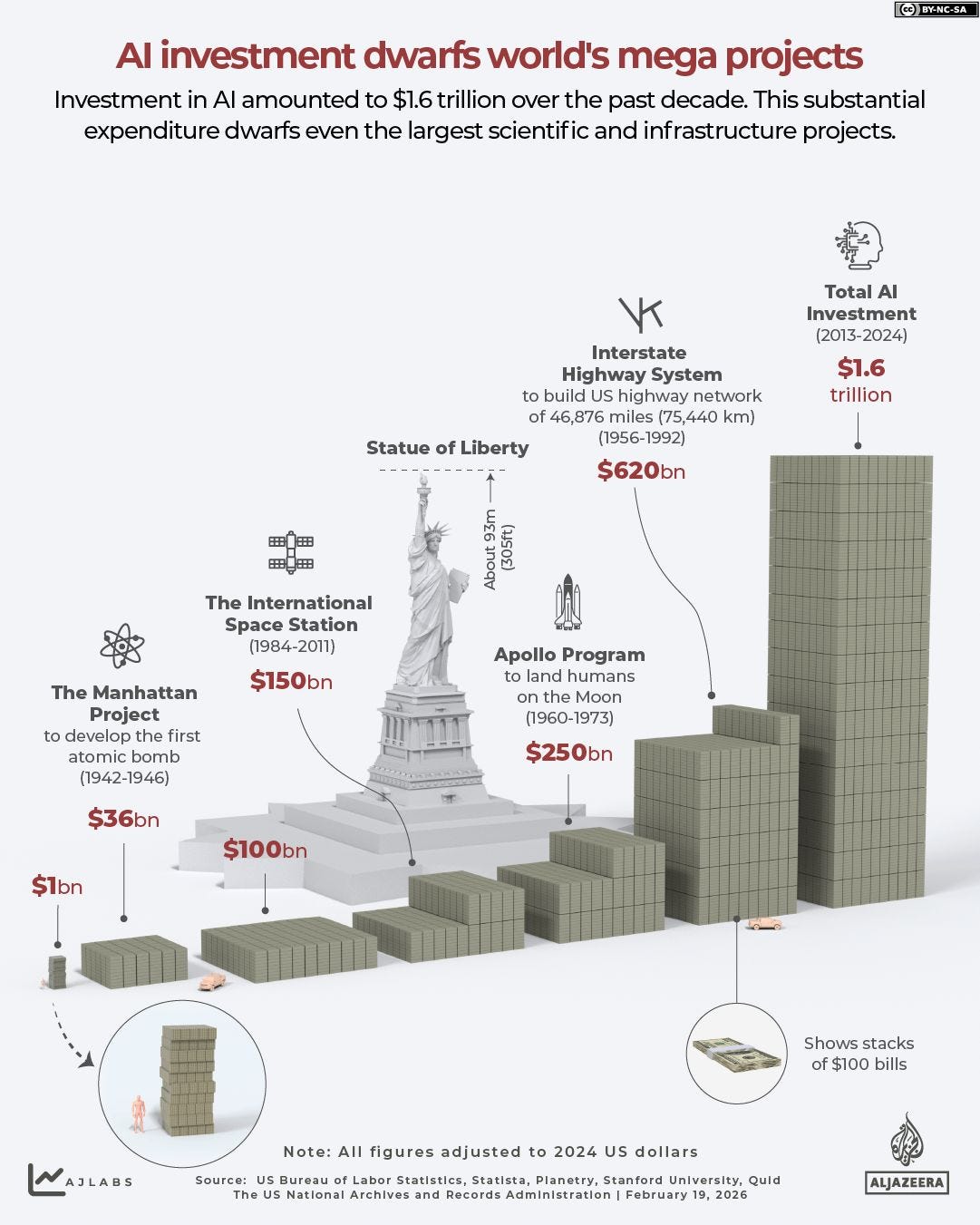
This article is the first in a series into Generalized AI Anxiety Disorder (GAAD). Put on your techno-armchair-psychology hat. In this moment, we are innovating cognition at scale. Trillions are being spent to develop products that reshape how our minds think in, learn from, and interact with the world.
Source: Al Jazeera2
These massive amounts of money fan embers of worry: what is hype? what is reality? Let’s take a biblical approach. Seeing what AI does to investors helps us understand what they will be comfortable with funding. How will the work life of a tech investor change?
This article offers several transferrable answers: the technical, rote skills lose value and will reshape firm cultures from the bottom-up. And the competitive edge on knowing more in the market appears all but gone. To be at the top, building trust with CEOs and management teams, cultivating relationships, and forming networks matter more than ever. The basis of competition is changing— and it makes the lessons learned in the classroom for an MBA worth more.

Source: Tuck Business School3
Most of the answers today originate from professional conversations. Last Friday, I attended a Private Equity and Venture Capital (PE/VC) conference at Dartmouth’s Business School.
At the conference, AI anxiety seeped into every panel and conversation — professors scrambling to update their curriculums, fund owners calming stressed endowment chiefs, directors struggling to sell businesses amid the messy macro environment, analysts justifying their existence against agents, and MBA students catastrophizing about their job prospects.
Source: Funding Blueprint, 20264
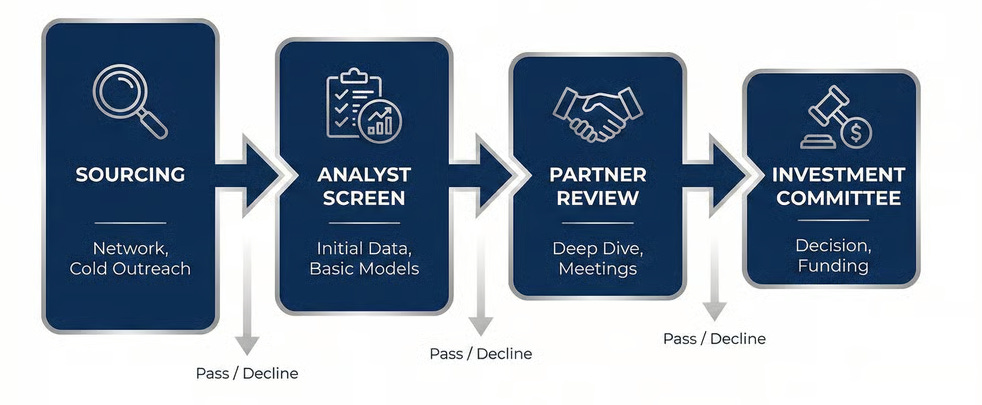
AI will change the fabric of deal flow and will influence firm culture. The funnel is getting faster; money can reach the best founders and their companies quicker because the technical and rote work— like researching markets, testing ideas about them, personalizing outreach to hundreds of companies, and modeling out their fundamentals—is accelerating.
The less humans are involved in these new processes, the more the roles change. What do funds look for in their new hires? If new tools can draft market research and outreach instantly, how does that change the cadence of weekly meetings throughout a firm? What happens to culture? That’s often defined by founders and their empirical observations. Mined from the earth, leaders look at what existing processes work in their companies and codify them into values.
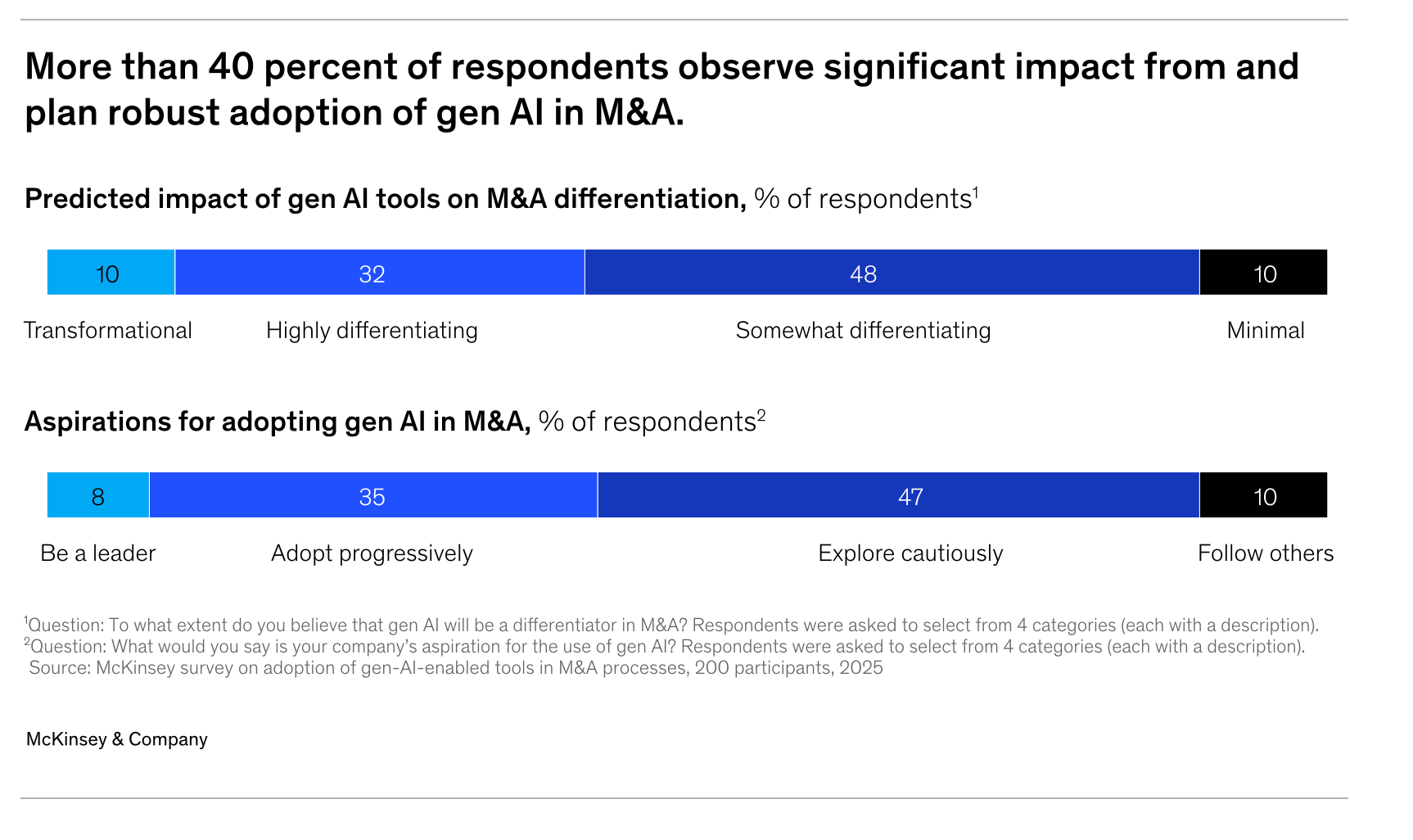
Data has grown more accessible and now AI models flatten the knowledge gap even among the best investors. Investors have long known that “money is green everywhere”, but now open knowledge stands to be commoditized too.
Source: McKinsey & Company5
What remains different is that closed knowledge, built from years of internal indices from firms own data, was a premium to develop subject matter expertise. But, large datasets with the best models have undermined the confidential intelligence that underpinned the old guard’s wisdom. Godly sums are being spent by top firms to build out their own AI tools from their private histories, but development lags, and adoption is even slower.
Nothing diminishes anxiety faster than taking action. - Walter Anderson6
It behooves anyone with Generalized AI Anxiety Disorder to take action. Stay apprised of updates changing their industry— adopt, don’t stick your head in the sand.
For investors, AI tools will A) accelerate deal flow and reshape culture from the bottom-up and B) demand they leverage their closed datasets with leading models. But the oldest competitive edge is now more important than ever. It’s what fake brains cannot replace: a good human being in the flesh.
“Trust, people, and relationships matter more than ever”
Those were the lyrics on repeat for 10 hours. When trying to win a deal, lots of the levers relied on are becoming commoditized: the money offered is the same everywhere; AI is pushing their data the same direction.
So now, to build a competitive pipeline and create successful partnerships for great exits, there’s this elusive concept of building “trust”. CEOs and their management teams must trust the words of advice from investors. They’re not actually running the business after all.
It takes about 20 hours to go from an acquaintance to a friend, and they become a close friend after 200 hours. You have to put in the time.
Funds are placing a higher value on the EQ, emotional intelligence, as AI commoditizes other technical skills built on knowledge. AI tools do really well in modeling out a business’s finances to increase its bottom-line; AI tools struggle aiding investors with the emotional skills to improve trust in a CEO and its management team in getting to a deal and supporting the business for a happy exit.

Source: Freepix7
Seriously, can you imagine this? Yes, the beginning of the funnel is getting automated, but I lose my mind getting automated responses to emails and texts; I could never imagine talking about the future of my startup on some roadshow in front of a bunch of androids. Immediate firing squad.
In the stage of getting to a deal, the best investors try plenty of ways to signal trust that they will care once a handshake happens. They’ll go out “into the field” in their Patagonia vest or whatever is fashionable in their target industry. They’ll buy every product, tour their factories, take their vitamins— whatever it takes because word gets around.
Identifying companies has gotten easier, but standing out to court the best businesses takes years of relationship building: knowing the lingo and everyday news, treating other ongoing partnerships right, and being a thought leader on emerging trends for guidance. This kinda sounds like dating.
Once the deal is struck, trust becomes a key component to ensure an investment performs. As a general partner noted, “…don’t say you’re going to improve them, that’s lame and rude. It’s support — I am a Sherpa at base camp for you while you go higher.”
Managing directors take careful time coaching analysts what to reveal about the plans for a company from entry-level teams all the way up to the c-suite, CEO, and boards. Corporate code switching. Imagine the fallout if some clever employee at a portfolio company could get a Private Equity’s chatbot to reveal its intended goal is to “reduce headcount” of their specific team.
How about that MBA?
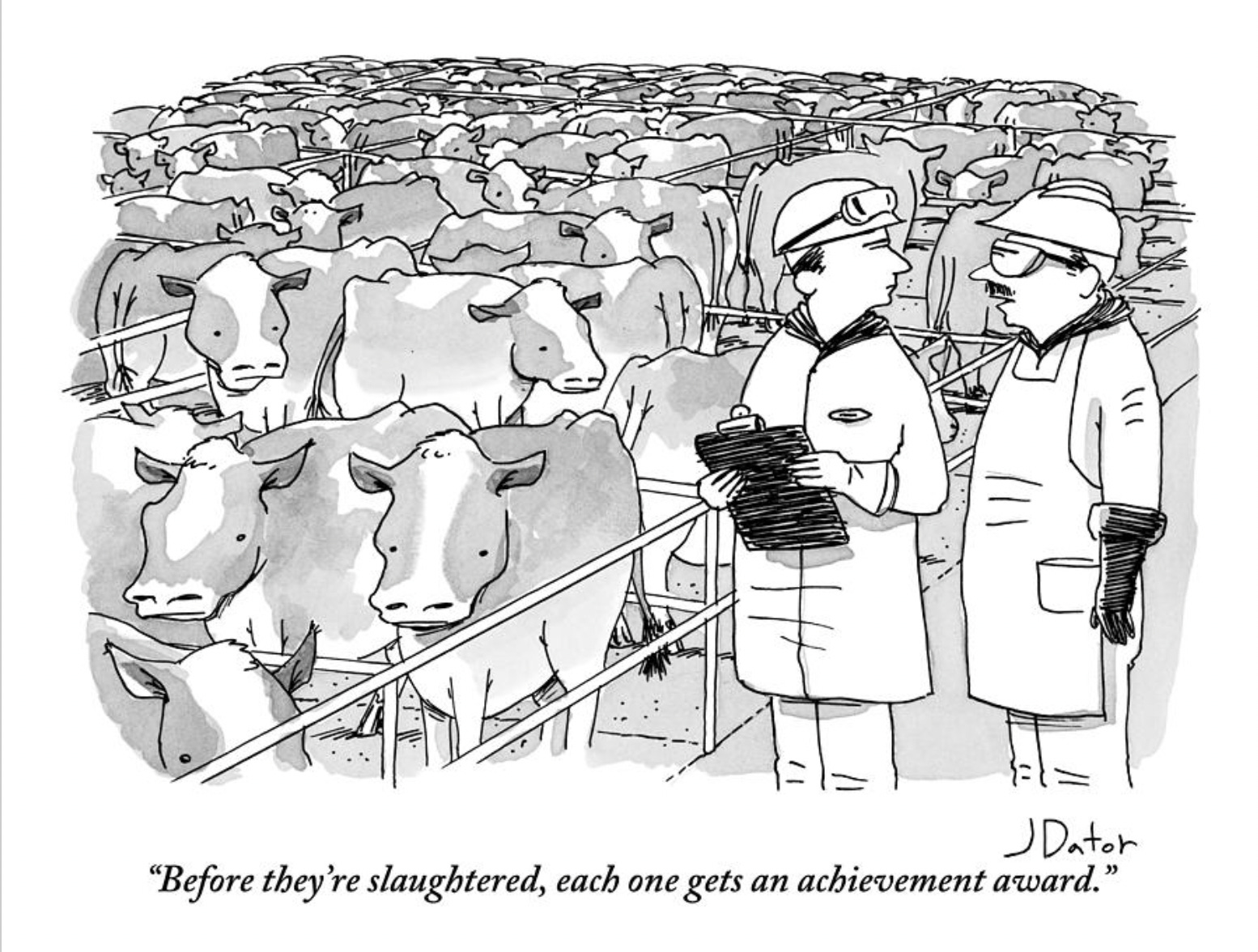
Even after the hype passes, artificial intelligence will introduce new tools that innovate workflows and create new cultures. A panelist caught himself ruminating out loud to dozens of MBAs: “now i’m asking myself, does our own headcount growth slow because of AI? We’re reviewing how many people we hire.” So much for EQ. The anxious silence that followed spoke volumes… do these students think they’re cattle in a classroom— being herded into unemployment?
Source: Joe Dator, New Yorker8
Are MBAs wasting their time in a classroom right now? Are they headed into a managerial slaughterhouse? No, these jobs will still need to exist and MBAs teach the fleshy skills of earning trust, building relationships, and forming networks.
The value of an elite MBA is relatively higher right now because the current wave of AI is replacing the skills practiced daily in the workforce. The degree’s familiar tradeoffs do still apply.
Agents that build models, slide decks, and code faster threaten the productive sovereignty of students. They’ll need to upskill to wield it. But how different is that from the history major learning to build a spreadsheet without their mouse? Indeed, whoever “built” the conference website didn’t bother testing it on mobile. So I plagiarized rehosted it the morning of the conference. To get the little things done, these students need to understand responsible agentic engineering: architecting secure systems, knowing what inputs to choose, and understanding whether the output “feels” right— which they’ve spent time in the trenches grasping before agents made it obsolete.
As the ground shifts under our feet, these students sit in classrooms teaching them the skills that automated brains cannot recreate— how to build trust, form relationships, be a better person, and hopefully think beyond a multiple.
For more reading
A few disclaimers. Much of the source material comes out of Chatham House Rules: names stay in the room; the ideas don’t have to. I know my subscriber base has lived more than me here so I urge you to reach out where I’m wrong. My early career has exposed me to various jobs and clients in this world: studies, venture, growth equity, wealth management, startups, think tanks, the intelligence community, and hedge funds among them. In this moment of history, one of life’s greatest joys is anyone can learn from anywhere and anyone. I enjoyed meeting everyone and hope to stay in touch with all of you. Cheers.
Screenshot, iPhone. Date redacted.
Tuck School of Business at Dartmouth, Tuck Launches MBA Application for the Class of 2027: https://tuck.dartmouth.edu/news/articles/tuck-launches-mba-application-for-the-class-of-2027
Tuck Facilities: https://facilities.tuck.dartmouth.edu/event-planning/venues/panels-meetings-conferences
Funding Blueprint, How VC Pitch Decks Work (2026): https://fundingblueprint.io/how-vc-pitch-decks-work
McKinsey & Company, Gen AI in M&A: From Theory to Practice to High Performance: https://www.mckinsey.com/capabilities/m-and-a/our-insights/gen-ai-in-m-and-a-from-theory-to-practice-to-high-performance
Walter Anderson, The Confidence Course: Seven Steps to Self-Fulfillment — “Nothing diminishes anxiety faster than action.”

Joe Dator, The Dredgeman’s Revelation, The New Yorker (2010): https://www.newyorker.com/magazine/2010/07/26/the-dredgemans-revelation